

When one tooth is missing, you may be offered more than one way to replace it. Two commonly considered options are a dental implant with a crown and a traditional dental bridge. Understanding the bridge vs implant difference can help you discuss the most suitable option with your dentist based on your oral health, neighbouring teeth, bone support, budget and long-term goals.
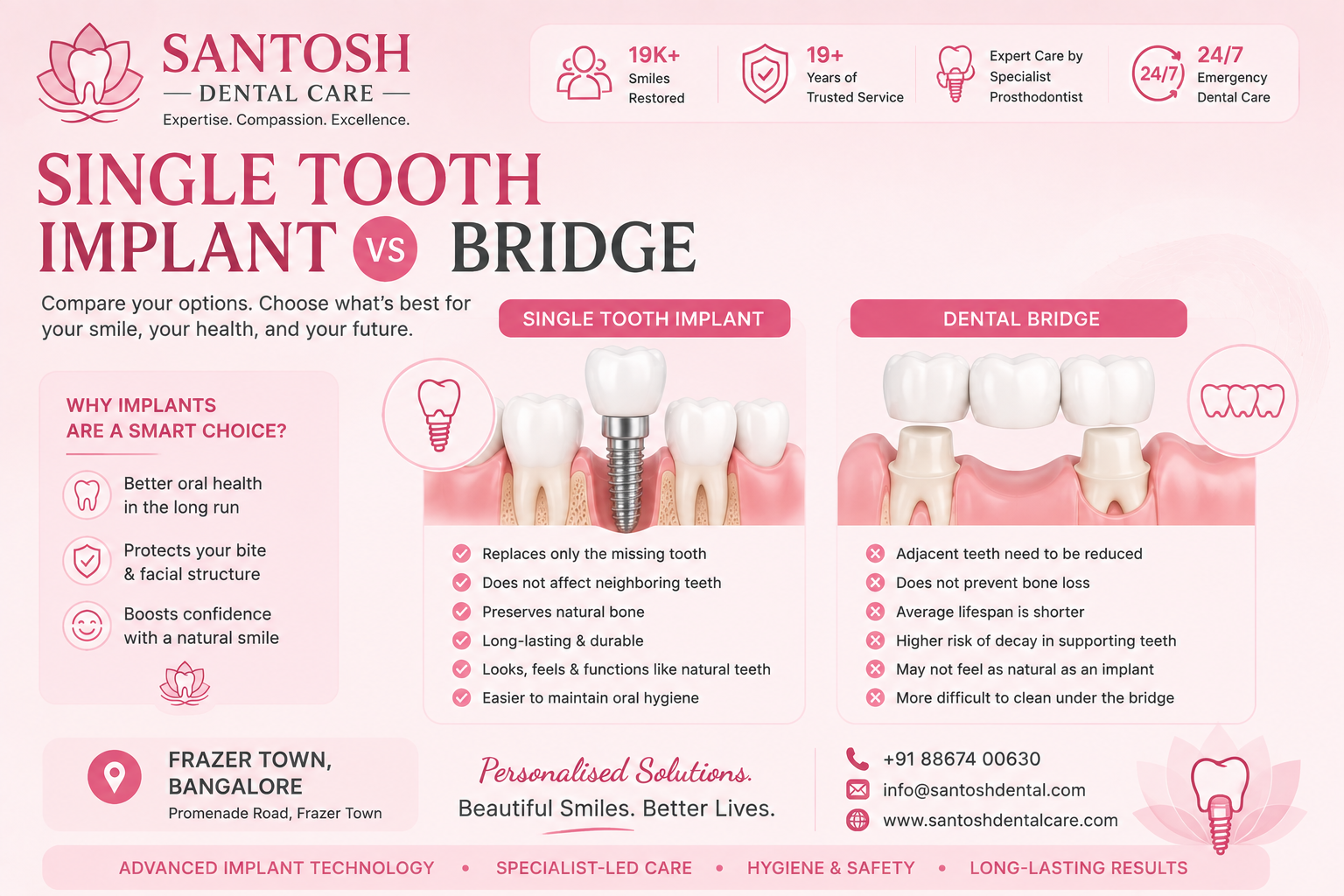
A dental implant replaces the missing tooth root with an implant fixture placed in the jawbone and supports a crown. A single tooth bridge replaces the missing tooth by using adjacent teeth as support.
Neither option is automatically right for everyone. The decision should follow a dental examination and appropriate diagnostic assessment.
At Santosh Dental Care, treatment planning is led by Dr. Sheetal B Saklecha, MDS – Prosthodontics & Crown/Bridge. The clinic’s current website highlights 19K smiles restored, 19+ years of trusted service, specialist-led treatment planning and 24/7 emergency dental care.
Book Appointment
Dental Bridge vs Implant: What Is the Difference?
The main difference between bridge and implant treatment is how the replacement tooth is supported.
A dental implant is placed into the jawbone at the site of the missing tooth. After appropriate healing, it supports an individual crown.
A dental bridge uses one or more neighbouring teeth as support for a replacement tooth suspended between them.
In simple terms:
| Feature | Dental Implant | Dental Bridge |
| Root replacement | Yes, with an implant fixture | No |
| Uses neighbouring teeth | Usually not for support | Yes |
| Surgery | Implant placement requires dental surgery | Usually no implant surgery |
| Treatment stages | Generally staged | Often fewer stages |
| Bone requirement | Adequate bone support is important | Does not require an implant to integrate with bone |
| Final restoration | Implant-supported crown | Bridge-supported artificial tooth |
| Maintenance | Requires implant and oral hygiene care | Requires cleaning around and under the bridge |
Your dentist can explain which option fits your particular situation.
How Does a Single Tooth Implant Work?
A dental implant bridge is sometimes confused with a single implant crown. For one missing tooth, the more typical implant solution is an implant-supported crown.
Treatment generally involves:
1. Examination and Diagnosis
Your dentist examines the missing-tooth area, neighbouring teeth, gums and bite. X-rays or other imaging may be recommended when necessary.
2. Implant Planning
The implant position is planned according to bone availability, anatomical structures, bite and the desired final crown.
3. Implant Placement
The implant fixture is placed into the jawbone using appropriate anaesthesia.
4. Healing
The implant needs time to integrate with the surrounding bone. The healing period varies according to the individual case.
5. Crown Placement
Once the implant is clinically ready, a custom-made crown is fitted to restore the missing tooth.
Santosh Dental Care describes its implant planning as focused on bite balance, long-term comfort and stable chewing, with consultation and digital diagnosis forming part of its patient journey.
How Does Dental Bridge Treatment Work?
Dental bridge treatment generally involves using the teeth adjacent to the missing space as supports.
The dentist evaluates the supporting teeth before recommending a bridge. If they are suitable, the supporting teeth may be prepared to receive crowns that are connected to the replacement tooth.
The process can involve:
- Examination of the missing tooth and neighbouring teeth
- Assessment of gum and oral health
- Preparation of supporting teeth when required
- Dental impressions or digital scans
- Fabrication of the bridge
- Fitting and adjustment
- Follow-up to assess comfort, bite and hygiene
A bridge can provide a fixed replacement without implant surgery, but the condition and suitability of the supporting teeth are important considerations.
Bridge vs Implant: Which Has More Advantages?
The answer depends on your circumstances.
Potential Advantages of a Dental Implant
A dental implant may:
- Replace the missing tooth without using adjacent teeth for support
- Provide a fixed tooth replacement
- Restore chewing function
- Provide an individual restoration for the missing tooth
- Be suitable when neighbouring teeth are healthy and the patient has adequate bone support
However, implant placement requires dental surgery, healing and careful maintenance.
Potential Advantages of a Dental Bridge
A bridge may:
- Replace a missing tooth without implant placement
- Usually involve fewer surgical stages
- Provide a fixed replacement
- Be suitable when neighbouring teeth already require crowns or significant restoration
- Avoid the need for implant integration with the jawbone
However, a conventional bridge relies on neighbouring teeth for support.
Which Is Better: Bridge or Implant?
If you are asking which is better bridge or implant, there is no universal answer.
An implant may be attractive when the neighbouring teeth are healthy and you want to replace the missing tooth without preparing those teeth for bridge support.
A bridge may be considered when the adjacent teeth already require crowns, when implant surgery is not preferred, or when other clinical factors make a bridge more suitable.
Your dentist should consider:
- Health of adjacent teeth
- Gum condition
- Jawbone availability
- Bite forces
- Oral hygiene
- Location of the missing tooth
- Existing dental restorations
- General health
- Treatment timeline
- Your preferences and expectations
The objective should be a clinically appropriate restoration rather than automatically selecting the newest or fastest treatment.
Dental Implant Bridge vs Traditional Bridge
The term implant bridge generally refers to a bridge supported by dental implants rather than natural teeth. This is different from replacing one missing tooth with one implant-supported crown.
An implant-supported bridge may be considered when several neighbouring teeth are missing and the treatment plan is designed to use fewer implants to support multiple replacement teeth.
For a single missing tooth, however, your dentist may discuss an individual implant-supported crown or a conventional bridge depending on the case.
This distinction is important when comparing treatment options because the number of missing teeth changes the treatment design.
What About Cost?
Cost should be considered, but it should not be the only deciding factor.
The cost of an implant can be influenced by:
- Implant system
- Crown material
- Diagnostic imaging
- Bone condition
- Additional procedures
- Gum treatment
- Number of appointments
The cost of a bridge can depend on:
- Number of units
- Materials used
- Condition of supporting teeth
- Laboratory work
- Additional dental treatment
When comparing dental bridge vs implant, ask for a complete treatment plan rather than comparing only the initial quoted price.
Which Option Is Better for Healthy Neighbouring Teeth?
If the teeth beside the missing tooth are healthy, an implant can be considered because it does not require those teeth to serve as conventional bridge supports.
However, this does not automatically mean an implant is the correct choice. Bone availability, gum health, bite and other clinical factors still need to be assessed.
If the neighbouring teeth already have extensive restorations or require crowns, a bridge may sometimes provide a practical treatment option.
What Does Santosh Dental Care Consider Before Treatment?
Santosh Dental Care follows a consultation-first approach. Its published patient journey includes consultation and digital diagnosis, explanation of multiple treatment options, a clear treatment plan, treatment and aftercare follow-up.
Dr. Sheetal B Saklecha is identified as the Lead Dentist & Prosthodontist, with MDS – Prosthodontics & Crown/Bridge qualifications. The clinic states that she leads treatment planning for implants, smile corrections and restorative cases.
The clinic also highlights:
- 19K smiles restored
- 19+ years of trusted service
- Specialist-led prosthodontic treatment planning
- Advanced technology
- Clear treatment explanations
- Hygiene and sterilisation protocols
- Bite-focused treatment planning
- Implant and restorative care
- 24/7 emergency dental care
This approach helps patients understand not just what treatment is available, but why a particular option may be recommended.
Questions to Ask Before Choosing an Implant or Bridge
Before deciding between an implant and bridge, ask:
- Are my neighbouring teeth healthy?
- Do I have enough bone for an implant?
- Will I need bone grafting?
- Which option is better for my bite?
- How many appointments will I need?
- What will the final restoration look like?
- What maintenance will be required?
- What are the alternatives?
- What is included in the quoted treatment cost?
- What happens if I delay replacing the missing tooth?
Having these questions answered can help you make a decision based on your individual needs.
Book Consultation
Choosing between a bridge vs implant should be based on your oral health rather than a generic claim about which treatment is “best.”
At Santosh Dental Care in Frazer Town, Bangalore, Dr. Sheetal B Saklecha and the dental team assess the missing tooth, surrounding teeth, gums, bite and restoration requirements before recommending an appropriate treatment pathway.
If you have one missing tooth and are comparing a dental bridge vs implant, schedule a consultation to understand the benefits, limitations, treatment stages and maintenance requirements of each option.
