

When a tooth needs to be removed, one of the questions patients commonly face is whether a dental implant should be placed immediately or after the extraction site has healed. Both approaches can be appropriate, but the right choice depends on the condition of the tooth, gums, jawbone, bite and overall treatment requirements.
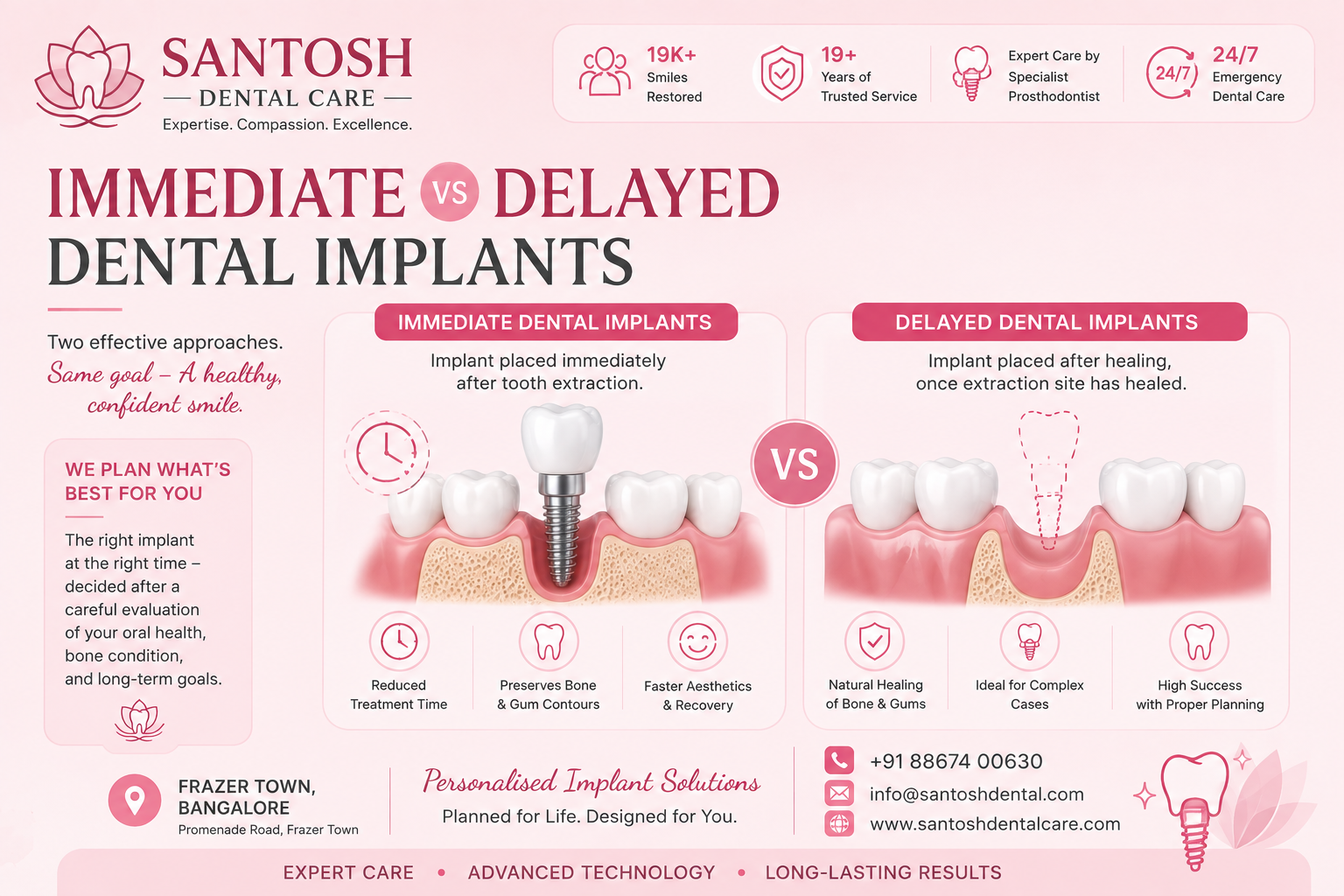
Immediate implant placement means placing the implant during the same appointment as tooth removal when the clinical conditions are suitable. With delayed implantation, the extraction site is allowed to heal before the implant is placed.
At Santosh Dental Care, implant treatment is planned according to individual clinical findings rather than using the same approach for every patient. The clinic is led by Dr. Sheetal B Saklecha, MDS – Prosthodontics & Crown/Bridge, and currently highlights 19K smiles restored, 19+ years of trusted service, and 24/7 emergency dental care.
What Is Immediate Implant Placement?
Immediate implant placement involves removing a tooth and placing the implant into the extraction socket during the same treatment visit.
This approach may reduce the time between tooth removal and implant placement and can help preserve the architecture of the extraction site when appropriate case selection is possible.
Santosh Dental Care states that immediate implants may be considered when adequate bone quality is available, there is no active infection, gum tissues are healthy and bite forces can be appropriately controlled.
However, immediate placement does not mean that every patient receives a permanent replacement tooth on the same day.
Book Appointment
What Is Delayed Implantation?
With delayed implantation, the tooth is removed first and the extraction site is allowed to heal before the implant is surgically placed.
This may be recommended when:
- The extraction site needs time to heal
- There is active infection
- Bone support is inadequate
- Gum health needs improvement
- Additional bone treatment is required
- Immediate implant stability cannot be predictably achieved
- The dentist considers staged treatment more appropriate
Delayed treatment is not necessarily a slower or inferior option. In some cases, allowing the tissues to heal first can provide a more suitable foundation for implant placement.
Immediate vs Delayed Dental Implants: Key Differences
| Factor | Immediate Implant | Delayed Implant |
| Implant placement | Usually during tooth removal | After extraction-site healing |
| Waiting period before implant placement | Reduced | Longer |
| Case selection | More stringent | Can accommodate cases needing healing |
| Active infection | Usually unsuitable | May allow treatment before placement |
| Bone condition | Requires suitable support/stability | Allows time for bone management when required |
| Treatment planning | Extraction and implant planning together | Staged approach |
| Temporary tooth | May be possible in selected cases | Depends on treatment stage |
| Suitability | Selected patients | Often preferred when healing is required |
The important point is that neither approach is automatically better. The objective is to select the safest and most clinically appropriate treatment for the individual patient.
Benefits of Immediate Dental Implants
When properly selected, immediate dental implants may offer several potential advantages.
Reduced Treatment Stages
The implant can be placed during the extraction appointment, potentially reducing the number of separate surgical visits.
Shorter Gap Before Implant Treatment
Patients do not necessarily have to wait for a completely healed extraction site before beginning implant placement.
Preservation of the Extraction Site
Immediate placement may help maintain the shape of the extraction area when the surrounding bone and tissues are suitable.
Earlier Tooth Replacement Planning
In selected cases, a temporary restoration may be considered after implant placement. This depends on implant stability, bone quality, gum condition and bite forces.
When Is Delayed Implant Placement Better?
Delayed implantation may be more appropriate when the extraction site requires additional treatment before an implant can be safely placed.
Your dentist may recommend waiting when there is:
- Active infection
- Significant bone loss
- Poor gum health
- Insufficient implant stability
- Complex extraction-site anatomy
- Need for bone grafting
- Uncontrolled oral-health problems
- Excessive bite pressure
Santosh Dental Care specifically notes that immediate implants may not be advised when infection is present, bone support is inadequate, gum health is compromised or excessive bite pressure exists.
What Are Immediate Loading Implants?
Patients sometimes confuse immediate implant placement with immediate loading implants.
They are not the same thing.
Immediate implant placement refers to when the implant fixture is inserted in relation to tooth removal.
Immediate loading refers to placing a functional restoration on an implant within a short period rather than waiting for conventional healing before loading it.
Immediate loading is only possible in selected situations where the implant has sufficient stability and other clinical conditions are appropriate.
A patient may therefore receive an immediate implant without receiving a permanent tooth on the same day.
How Does the Dentist Decide Between the Two?
The decision should follow a detailed clinical assessment.
At Santosh Dental Care, the implant consultation can include:
- Examination of the affected tooth
- Assessment of gum health
- Evaluation of surrounding teeth
- Dental X-rays or scans when appropriate
- Assessment of bone availability
- Evaluation of bite and functional forces
- Discussion of restoration options
- Explanation of immediate and delayed treatment pathways
The clinic describes its implant consultations as involving oral and bone assessment, review of dental imaging, discussion of suitable implant options and explanation of treatment stages and timelines.
What Happens During Immediate Implant Treatment?
When a patient is suitable for immediate placement, treatment generally follows a structured sequence.
Step 1: Evaluation
The tooth, gums, bone and bite are assessed before treatment.
Step 2: Imaging
Dental X-rays or other appropriate imaging may be used to understand the anatomy and plan implant positioning.
Step 3: Tooth Removal
The affected tooth is carefully removed with attention to preserving surrounding tissues where possible.
Step 4: Immediate Implant Placement
If the site meets the required clinical criteria, the implant is positioned into the extraction socket.
Step 5: Healing
The implant remains in place while it integrates with the surrounding bone.
Step 6: Restoration
Once clinically appropriate, the final crown or implant-supported restoration is fitted.
Santosh Dental Care also states that microscope-assisted dentistry is used for improved visibility and precision during implant-related procedures, while CEREC technology is available for digital crown design and in-clinic milling.
Is Immediate Implant Treatment Right for You?
Searching online for the best dental clinic or the best dentist in Bangalore should not replace a clinical evaluation.
Immediate treatment may sound attractive because it can reduce waiting between extraction and implant placement. However, choosing it simply because it is faster may not be appropriate if your bone or gum condition requires healing first.
Similarly, patients searching for an affordable dental clinic near me should compare the quality and completeness of the treatment plan rather than choosing a provider solely on price.
The right question is not:
“Which option is fastest?”
It is:
“Which option gives my tooth replacement the most appropriate clinical foundation?”
Why Choose Santosh Dental Care for Implant Planning?
Santosh Dental Care follows a patient-first, quality-focused approach to implant treatment. The clinic’s published implantology information highlights microscope-assisted precision dentistry, advanced implant planning tools, in-house dental X-rays and investigations, and a hygienic clinical environment.
Dr. Sheetal B. Saklecha is identified as a BDS, MDS – Prosthodontics & Crown Bridge specialist with expertise in dental implants, full-mouth rehabilitation and restorative treatment planning. The clinic describes her approach as focused on clear communication, precision and long-term oral function.
Patients also have access to 24/7 emergency dental care for urgent dental concerns, according to the clinic’s current website.
Book Appointment
What Should You Ask Before Choosing Immediate or Delayed Implants?
Before starting treatment, ask your dentist:
- Is immediate implant placement suitable for my case?
- Is there any infection at the extraction site?
- Do I have enough bone for immediate placement?
- Will I need bone grafting?
- Can the implant be immediately loaded?
- Will I need a temporary tooth?
- How long will healing take?
- What type of final crown is planned?
- What are the alternatives to an implant?
- What follow-up will I need?
Understanding these answers can help you make a decision based on your oral health rather than treatment speed alone.
