

Discreet Orthodontic Treatment for Straighter Teeth and a Balanced Bite
Crooked teeth, gaps, crowding and certain bite problems can affect both the appearance and function of your smile. If you want to straighten your teeth without the visible brackets and wires associated with conventional braces, clear aligners may be an option worth discussing with a dental professional.
At Santosh Dental Care, Frazer Town, clear aligners are considered as part of personalized orthodontic treatment planning. The clinic’s orthodontic approach evaluates tooth position, bite relationship, jaw alignment, treatment complexity and lifestyle before recommending an appliance.
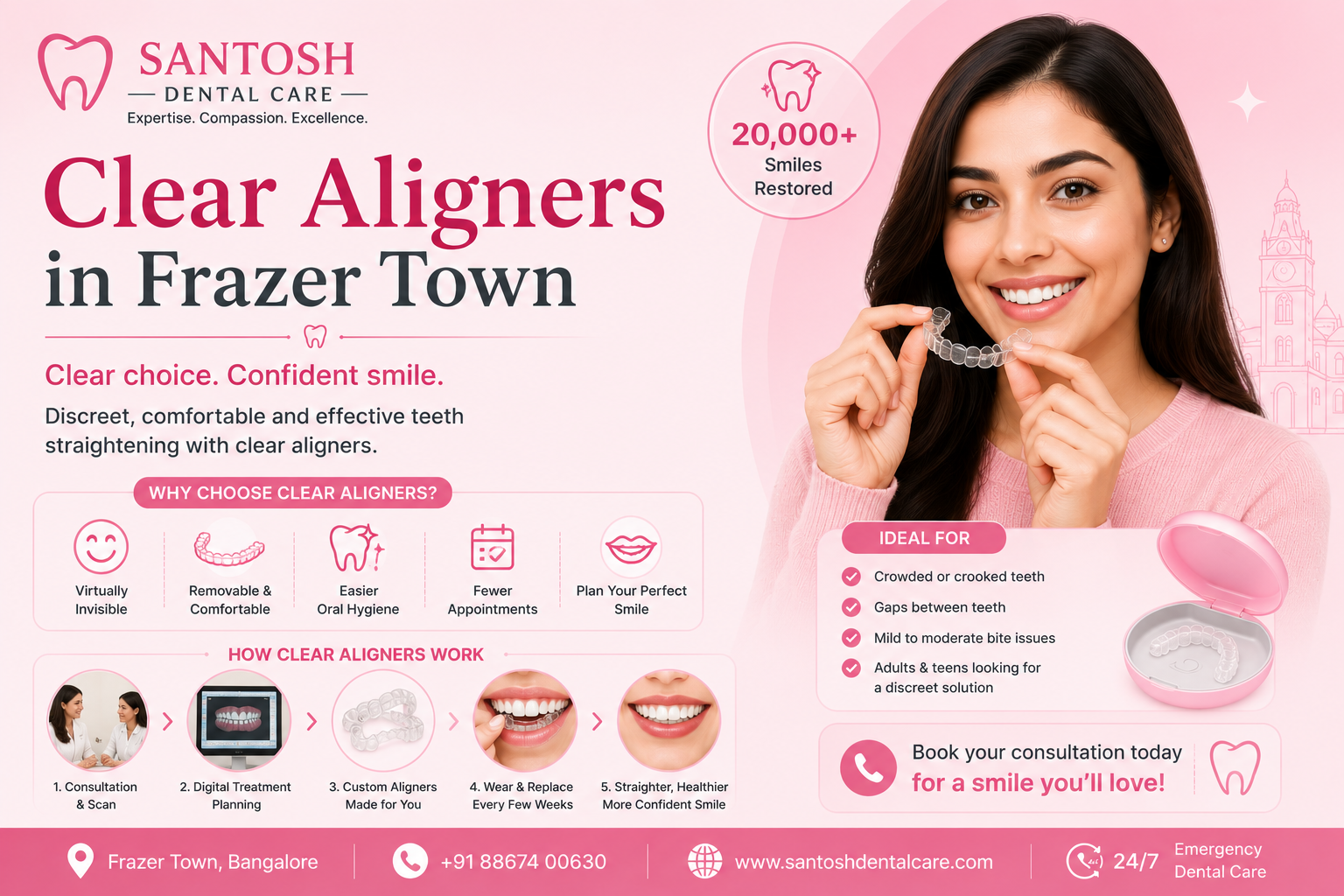
Clear aligners are transparent, removable trays designed to move teeth progressively through planned stages. They can provide a discreet alternative to conventional fixed braces for selected cases, but they are not suitable for every orthodontic problem.
The clinic is led by Dr. Sheetal B. Saklecha, BDS, MDS – Prosthodontics & Crown & Bridge, who has over 21 years of overall clinical experience and more than 20 years of specialist practice.
What Are Clear Aligners?
Clear aligners are removable orthodontic trays made to fit over your teeth. Instead of using brackets and wires, a sequence of trays is used to create planned tooth movement.
Book Appointment
Each stage is designed to move selected teeth gradually. As treatment progresses, the patient changes to the next aligner according to the prescribed treatment schedule.
Clear aligners may be considered for selected concerns such as:
- Mild to moderate crowding
- Certain gaps between teeth
- Some alignment problems
- Selected bite corrections
- Relapse after previous orthodontic treatment
The suitability of aligner treatment depends on the complexity of the case.
Santosh Dental Care states that its orthodontic treatment is customized according to dental structure, jaw alignment, bite and lifestyle requirements.
Clear Aligners vs Invisible Braces
Patients often search for invisible braces, invisible teeth braces or dental aligners when they want a less noticeable way to straighten their teeth.
The terminology can be confusing.
Clear aligners are removable transparent trays. The term “invisible braces” is often used more broadly for discreet orthodontic treatments, including clear aligners and sometimes ceramic braces.
The important consideration is not the name used to describe the appliance. Your dentist should determine whether the appliance can achieve the tooth movements required in your particular case.
Who Can Consider Clear Aligners?
Clear aligners may be suitable for patients with certain:
- Crooked teeth
- Mild to moderate crowding
- Spaces between teeth
- Relapsed orthodontic cases
- Selected bite problems
- Cosmetic alignment concerns
However, complex cases may require conventional braces or other orthodontic appliances.
Your dentist may evaluate:
- Tooth position
- Root position
- Gum health
- Bone support
- Bite
- Jaw relationship
- Required tooth movements
- Patient compliance
This evaluation helps prevent unrealistic expectations about what aligners can achieve.
How Does Clear Aligner Treatment Work?
1. Initial Consultation
Your dentist discusses your concerns and examines your teeth, gums and bite.
The goal is to understand not only how your teeth look but also how they function.
2. Digital Diagnosis
Digital photographs, scans, X-rays or other diagnostic records may be recommended depending on your case.
Santosh Dental Care’s patient journey emphasizes consultation and digital diagnosis before treatment planning.
3. Treatment Planning
Your dentist determines whether clear aligners are appropriate and explains the expected treatment stages.
4. Aligner Fabrication
A series of customized aligners is prepared according to the approved treatment plan.
5. Progressive Tooth Movement
You wear each aligner according to the instructions provided by your dental team. Each stage is intended to produce controlled movement.
6. Regular Monitoring
Follow-up appointments allow the dentist to assess progress and make adjustments when necessary.
7. Retention
Once active treatment is completed, retainers are generally required to help maintain the corrected tooth positions.
How Long Do Clear Aligners Take?
There is no universal clear-aligner treatment duration.
The timeline depends on:
- Number of teeth requiring movement
- Severity of crowding
- Spacing
- Bite correction
- Complexity of tooth movement
- Patient compliance
- Biological response
- Need for additional orthodontic procedures
Some relatively straightforward cases may require less treatment time, while more complex cases can take considerably longer.
Santosh Dental Care explains that orthodontic treatment can range from several months to a few years depending on alignment and bite complexity.
Therefore, it is better to obtain a personalized timeline after an examination rather than relying on a generic treatment duration advertised online.
What Is the Cost of Clear Aligners?
Patients commonly search for invisalign cost, invisible aligners cost or the price of teeth aligners before booking a consultation.
There is no single cost that applies to every patient.
Your treatment cost can depend on:
- Complexity of tooth movement
- Number of aligners required
- Treatment duration
- Diagnostic records
- Attachments or other orthodontic requirements
- Follow-up appointments
- Retainers
- Whether additional dental treatment is needed
If a provider quotes an aligner price online, check what the quoted amount actually includes.
A personalized treatment estimate is more useful than comparing starting prices without knowing whether diagnostics, refinements, retainers and follow-up care are included.
Invisalign and Clear Aligners: Are They the Same?
Patients frequently use terms such as invisalign braces or Invisalign aligners when searching for clear orthodontic treatment.
It is useful to distinguish between a specific branded aligner system and the broader category of clear aligners.
“Invisalign” refers to a specific branded clear-aligner system, while clear aligners is the general term for transparent removable orthodontic trays.
If you are specifically considering Invisalign, your dentist should first determine whether aligner treatment is appropriate for your case and then discuss the available system and treatment plan.
The clinical suitability of the treatment is more important than selecting an aligner simply because it is marketed as discreet.
What About Whistle Aligners?
Whistle aligners is another term patients may encounter while researching clear orthodontic treatment.
When comparing different aligner systems, do not focus only on the brand name or advertised price.
Ask about:
- Who will diagnose and plan the treatment?
- How complex is your case?
- How frequently will your progress be reviewed?
- Are refinements included?
- Are retainers included?
- What happens if the teeth do not track as planned?
- What follow-up support is available?
Orthodontic treatment requires professional assessment and monitoring regardless of the aligner brand.
Clear Aligners vs Braces
Clear aligners are not automatically better than braces.
Clear Aligners
Potential advantages include:
- Less noticeable appearance
- Removable for eating
- Easier access for routine brushing
- No brackets and wires
However, successful treatment depends heavily on wearing the aligners as instructed.
Braces
Braces are fixed appliances that can provide precise control of tooth movement and may be appropriate for a broader range of alignment and bite problems.
The choice between the two depends on your diagnosis, treatment goals and lifestyle.
Santosh Dental Care’s orthodontic service lists both clear aligners and dental braces as treatment options selected according to the patient’s clinical requirements.
Is a Mouth Guard the Same as a Clear Aligner?
A mouth guard and a clear orthodontic aligner serve different purposes.
A mouth guard may be used to protect teeth during certain activities or, depending on the type, to manage specific dental concerns such as teeth grinding.
A clear aligner is an orthodontic appliance designed to progressively move teeth.
Although both can look like transparent trays, they should not be considered interchangeable.
Do not use a sports mouth guard or another dental appliance as a substitute for professionally planned orthodontic treatment.
Can Clear Aligners Give You “Perfect Teeth”?
Patients sometimes search for aligners because they want perfect teeth.
It is important to have realistic expectations.
Orthodontic treatment aims to improve tooth alignment, bite and function while creating an aesthetically pleasing result. Teeth are biological structures, and treatment outcomes depend on individual anatomy and response to treatment.
A good treatment plan should focus on:
- Healthy teeth and gums
- Functional bite
- Appropriate tooth alignment
- Comfortable chewing
- Long-term stability
- Natural-looking aesthetics
The objective should be a healthy, balanced and stable smile—not an unrealistic promise of perfection.
How to Care for Clear Aligners
Good hygiene is essential throughout treatment.
Your dental team may recommend:
- Cleaning aligners as instructed
- Maintaining regular tooth brushing
- Cleaning between teeth
- Removing aligners when instructed for eating
- Storing aligners safely when they are not being worn
- Attending scheduled reviews
- Following the prescribed wear schedule
Book Appointment
Poor compliance can affect treatment progress.
If an aligner no longer fits properly, becomes damaged or causes unexpected discomfort, contact your dental provider rather than attempting to modify it yourself.
Why Choose Santosh Dental Care for Clear Aligners in Frazer Town?
Santosh Dental Care takes a diagnosis-first and patient-focused approach to orthodontic treatment.
The clinic’s published orthodontic care emphasizes:
- Individualized treatment planning
- Assessment of tooth position
- Bite evaluation
- Jaw relationship assessment
- Digital diagnostic support
- Clear explanation of treatment options
- Regular monitoring
- Retention planning
- Long-term stability
Meet Dr. Sheetal B. Saklecha
Dr. Sheetal B. Saklecha, BDS, MDS – Prosthodontics & Crown & Bridge, leads treatment planning at Santosh Dental Care.
The current clinic profile states that she has over 21 years of overall clinical experience and more than 20 years of specialist practice. Her areas of expertise include dental implants, smile designing, cosmetic dentistry, crowns and bridges, dentures, full-mouth rehabilitation and restorative dentistry.
Santosh Dental Care’s current published content also states that Dr. Sheetal has contributed to restoring 20,000+ smiles and provides 24/7 emergency dental care for urgent dental concerns.
The clinic is located near Coles Park, Mosque Road and MM Road in Frazer Town, serving patients from nearby areas including Cox Town, Cooke Town, Shivajinagar, RT Nagar, Jayamahal, Banaswadi, Ulsoor, Indiranagar and Hebbal.
