

Choosing the Right Full-Mouth Implant Solution for Your Smile
When several teeth are missing, severely damaged or no longer suitable for restoration, replacing each tooth individually may not always be the most appropriate approach. Full mouth dental implants can provide a fixed, implant-supported solution for patients who require extensive rehabilitation.
Two commonly discussed approaches are all on 4 dental implants and All-on-6 dental implants. Both use multiple dental implants to support a full arch of replacement teeth, but the number and positioning of implants differ.
So, which is better: All-on-4 or All-on-6?
There is no universal answer.
The right approach depends on factors such as the condition and distribution of available jawbone, the health of your gums and remaining teeth, your bite, the arch being treated, functional requirements, and the type of final prosthesis planned.
At Santosh Dental Care in Frazer Town, Bangalore, implant treatment is planned after clinical examination and appropriate diagnostic evaluation. The clinic’s implant approach focuses on bite balance, long-term comfort, stable chewing and individualized treatment planning.
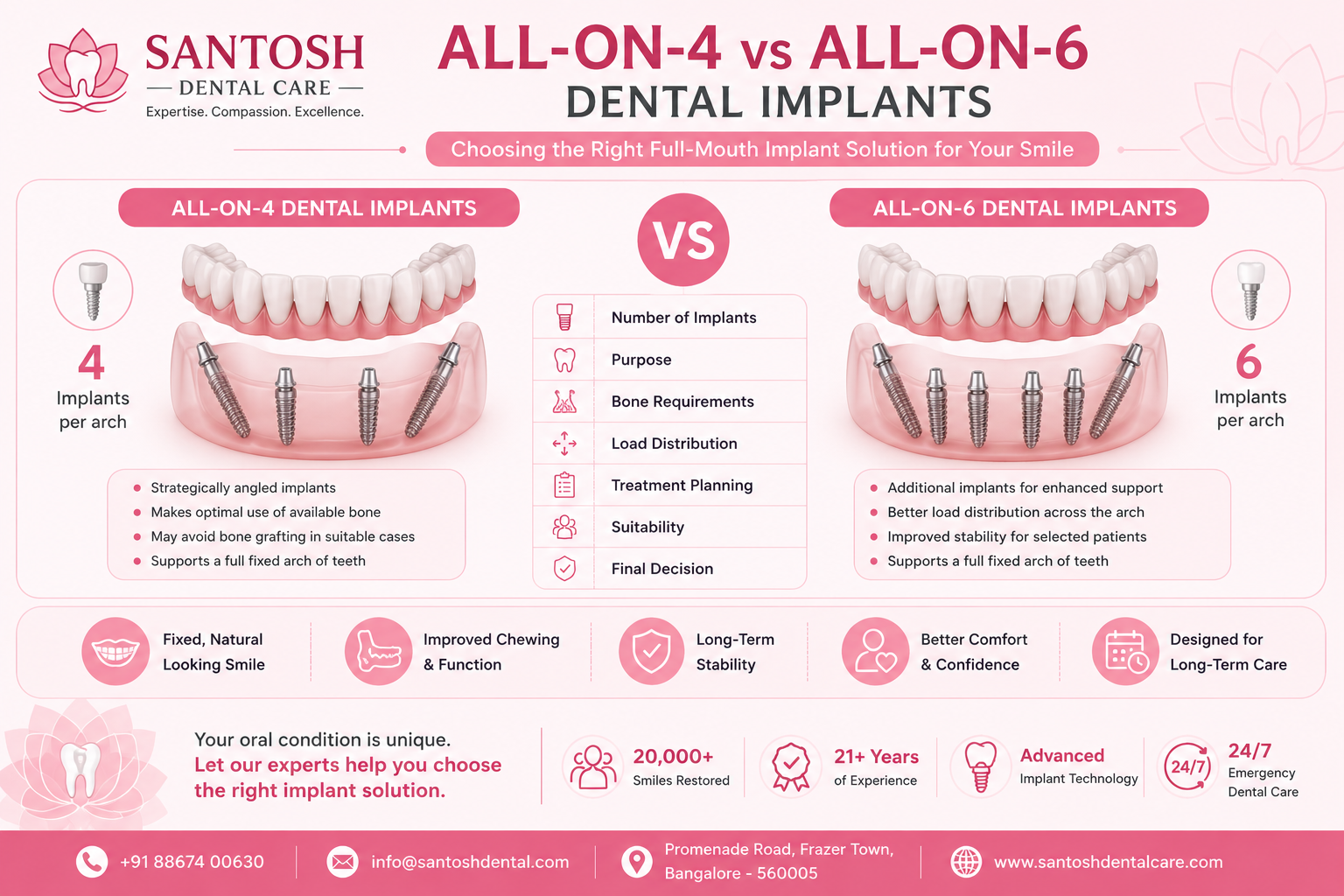
All-on-4 vs All-on-6: Quick Comparison
| Feature | All-on-4 Dental Implants | All-on-6 Dental Implants |
| Number of implants | Four implants per arch | Six implants per arch |
| Purpose | Support a complete fixed arch | Support a complete fixed arch |
| Bone requirements | Can make strategic use of available bone | Provides additional implant support where suitable |
| Load distribution | Load is distributed across four implants | Load is distributed across six implants |
| Treatment planning | Based on available bone and prosthetic requirements | Based on available bone, bite and prosthetic requirements |
| Suitability | Selected patients requiring full-arch rehabilitation | Selected patients where additional implant support is appropriate |
| Final decision | Requires individual clinical assessment | Requires individual clinical assessment |
The number of implants alone does not determine which treatment is better. A detailed evaluation is needed to understand which option is appropriate for your oral condition.
What Are All-on-4 Dental Implants?
All-on-4 dental implants are a full-arch implant treatment approach in which four strategically positioned implants are used to support a complete set of fixed replacement teeth for an arch.
The technique is designed to make strategic use of available jawbone. At Santosh Dental Care, All-on-4 treatment is described as a solution for patients with multiple missing or severely compromised teeth who require a stable fixed full-arch restoration.
All-on-4 may be considered when:
- Most teeth in an arch are severely damaged or non-functional.
- Several teeth are missing.
- Existing dentures are loose or uncomfortable.
- A patient wants a fixed full-arch solution.
- The available bone allows an appropriate implant plan.
- The patient requires comprehensive oral rehabilitation.
The actual suitability of all on 4 implants cannot be determined from the number of missing teeth alone. Bone anatomy, gum health, bite forces and the condition of the remaining teeth all need to be evaluated.
What Are All-on-6 Dental Implants?
All-on-6 uses six dental implants to support a complete fixed arch of replacement teeth.
Compared with an All-on-4 approach, two additional implants can provide another point of support for the planned prosthesis. Whether that additional support is beneficial depends on the patient’s anatomy, implant positioning, bite and prosthetic requirements.
All-on-6 may be considered when the clinical assessment indicates that a six-implant configuration is appropriate for supporting the planned full-arch restoration.
It is important to understand that having more implants does not automatically mean that All-on-6 is better for every patient.
The goal is to select an implant configuration that provides an appropriate balance of:
- Implant support
- Bone availability
- Bite forces
- Prosthetic design
- Oral hygiene access
- Long-term maintenance
- Patient-specific anatomical considerations
What Is the Main Difference Between All-on-4 and All-on-6?
The most obvious difference is the number of implants.
All-on-4: Four implants support one complete arch.
All-on-6: Six implants support one complete arch.
However, the clinical difference is more significant than simply counting implants.
With All-on-4, the treatment plan is developed around four strategically positioned implants and the available bone.
With All-on-6, the additional implants may provide further support and allow implant distribution to be planned differently, depending on the patient’s anatomy.
The choice should therefore be based on clinical suitability rather than the assumption that six implants are always superior to four.
All-on-4 vs All-on-6: Which Is Better?
Neither treatment is automatically better for everyone.
The appropriate option depends on your individual oral condition.
All-on-4 may be considered when:
- Four strategically positioned implants can provide adequate support.
- Available bone allows appropriate implant positioning.
- A complete fixed arch is required.
- The patient’s anatomy and bite are suitable for the planned restoration.
All-on-6 may be considered when:
- Additional implant support is clinically appropriate.
- Bone availability allows placement of six implants.
- The prosthetic design benefits from additional implant distribution.
- Bite forces and functional requirements support the approach.
The final decision should be made after clinical and radiographic evaluation.
How Does Bone Health Affect the Choice?
Bone condition is one of the important factors in implant planning.
Dental implants need appropriate bone support for stable placement. Bone volume and quality can vary significantly between patients, particularly after prolonged tooth loss.
A patient who has been missing teeth for many years may have experienced changes in the jawbone.
At Santosh Dental Care, CBCT and other appropriate imaging can be used when clinically indicated to assess the implant site and support treatment planning. The clinic’s implant approach emphasizes evaluation of bone support before deciding on the treatment pathway.
In some situations, a dental bone graft may be considered if there is inadequate bone for the planned implant treatment.
Bone grafting is not automatically required for every implant patient. It is recommended only when the clinical assessment indicates that additional bone support is needed.
Does Gum Health Matter Before All-on-4 or All-on-6?
Yes.
Healthy gums and adequate periodontal support are important considerations before extensive implant rehabilitation.
Active gum disease or untreated infection may need to be addressed before implant placement.
This is particularly important for patients who have:
- Bleeding gums
- Gum recession
- Loose teeth
- Persistent bad breath
- Gum swelling
- Previous periodontal disease
- Significant plaque or tartar accumulation
A comprehensive implant plan should therefore consider the condition of the entire mouth rather than looking only at the area where implants will be placed.
Can All-on-4 or All-on-6 Replace All Missing Teeth?
Both approaches are designed to support a complete arch of replacement teeth rather than replacing each missing tooth with an individual implant.
This can make full-arch rehabilitation different from conventional treatment involving one implant for each missing tooth.
For patients with severely damaged or missing teeth, a full-arch solution may help restore:
- Chewing function
- Bite stability
- Smile appearance
- Speech
- Dental support
- Overall oral function
However, the final treatment depends on the condition of the remaining teeth, jawbone, gums and the patient’s overall treatment goals.
What Happens During All-on-4 or All-on-6 Treatment Planning?
A comprehensive implant treatment plan usually begins with an assessment rather than immediate implant placement.
Step 1: Clinical Consultation
The dentist evaluates your teeth, gums, bite and overall oral condition.
Step 2: Diagnostic Imaging
Appropriate X-rays or CBCT imaging may be recommended to evaluate the jawbone and relevant anatomical structures.
Step 3: Treatment Planning
The number and position of implants, type of prosthesis and treatment sequence are planned according to your anatomy and functional needs.
Step 4: Preparation
Existing teeth that cannot be restored may require extraction. Gum treatment, infection management or bone grafting may also be necessary in selected cases.
Step 5: Implant Placement
The planned implants are surgically placed according to the treatment plan.
Step 6: Temporary or Provisional Teeth
Depending on the case and clinical protocol, a temporary prosthesis may be provided during the rehabilitation process.
Step 7: Final Prosthesis
Once the appropriate healing and clinical milestones are achieved, the final fixed full-arch prosthesis is fabricated and fitted.
Step 8: Maintenance
Regular dental reviews and professional maintenance remain important after implant rehabilitation.
Can All-on-4 or All-on-6 Be Used After Bone Loss?
Possibly, but this requires individual assessment.
Bone loss can occur after tooth loss, infection, trauma or prolonged use of certain dental prostheses.
The available bone determines where and how implants can be positioned.
In selected cases, implant planning may involve:
- Strategic implant positioning
- Bone grafting
- Other preparatory procedures
- Alternative implant approaches
The important point is that bone loss does not automatically mean that implant treatment is impossible.
It means the treatment plan may need to be modified.
Patients should not assume they require a particular implant technique based solely on an online search.
What About Zygomatic Implants?
Patients with severe upper-jaw bone loss may also come across zygomatic implants while researching full-mouth rehabilitation.
Zygomatic implants are different from conventional dental implants because they use the cheekbone region for implant support rather than relying entirely on the severely resorbed upper jaw.
However, they are not a routine alternative to All-on-4 or All-on-6.
They are considered for carefully selected patients with significant maxillary bone deficiency when conventional implant approaches may not provide an appropriate solution.
A detailed examination and advanced imaging are required before such treatment can be considered.
All-on-4 vs All-on-6 for Older Adults
Age alone does not determine whether a patient is suitable for full-arch implant treatment.
Older adults may still be candidates for implant rehabilitation when their oral and general health allows treatment.
The assessment may consider:
- Bone condition
- Gum health
- Existing teeth
- Bite
- Ability to maintain oral hygiene
- Medical history
- Healing considerations
- Functional requirements
The treatment plan should therefore be based on overall health and clinical suitability rather than age alone.
All-on-4 vs All-on-6: What Should You Consider?
When comparing the two treatments, ask your dentist:
- How much bone is available?
- Is the bone healthy enough for the planned implant placement?
- Are any teeth still worth preserving?
- Is gum treatment required before implants?
- Would four implants provide sufficient support?
- Would six implants provide a clinical advantage in my case?
- What type of final prosthesis is being planned?
- Will I need a temporary prosthesis?
- Will bone grafting or another preparatory procedure be required?
- What maintenance will be needed after treatment?
These questions are more useful than choosing a treatment simply because it uses more implants.
All-on-4 and All-on-6 at Santosh Dental Care
Santosh Dental Care in Frazer Town, Bangalore provides implant treatment with an emphasis on consultation, diagnosis, treatment planning and follow-up.
The clinic’s published implant information describes All-on-4 as a full-arch solution designed around strategically placed implants, while its broader dental implant services emphasize individualized planning according to bone support, bite and long-term functional requirements.
Treatment planning is led by Dr. Sheetal B. Saklecha, MDS – Prosthodontics & Crown & Bridge, whose listed areas of expertise include dental implants, full-mouth rehabilitation, crowns and bridges, dentures and restorative dentistry.
The patient journey at Santosh Dental Care begins with consultation and diagnosis, followed by explanation of treatment options and a planned treatment pathway with aftercare and follow-up guidance.
Why Choose Santosh Dental Care for Full-Mouth Implant Rehabilitation?
Patients considering full-arch implant treatment generally need more than implant placement alone. They need assessment, prosthetic planning, bite evaluation and long-term maintenance.
Santosh Dental Care highlights:
- Specialist-led treatment planning
- Dental implant and full-mouth rehabilitation expertise
- Digital diagnostic support
- Personalized treatment planning
- Implant and restorative treatment
- Prosthodontic expertise
- Hygiene-focused clinical protocols
- Follow-up guidance
- Frazer Town location in Bangalore
The clinic serves patients from areas including Frazer Town, Cox Town, Cooke Town, Shivajinagar, RT Nagar, Jayamahal, Banaswadi, Ulsoor, Indiranagar and Hebbal.
Conclusion
All-on-4 and All-on-6 dental implants are both full-arch implant approaches, but the right choice depends on the individual patient.
All-on-4 uses four strategically positioned implants, while All-on-6 uses six implants to support a complete arch. The decision should not be based simply on the number of implants. Bone availability, gum health, bite, remaining teeth, prosthetic design and long-term maintenance all need to be considered.
If you are considering all on 4 dental implants or full-mouth implant rehabilitation in Bangalore, a detailed clinical and imaging assessment can help determine which approach is appropriate for your oral condition.
