

Personalized Orthodontic Care for Straighter Teeth and a Balanced Bite
Crooked, crowded or spaced teeth can affect more than the appearance of your smile. They can make cleaning difficult, affect chewing and contribute to an uneven bite. Orthodontic treatment can gradually move teeth into healthier and more functional positions while improving smile aesthetics.
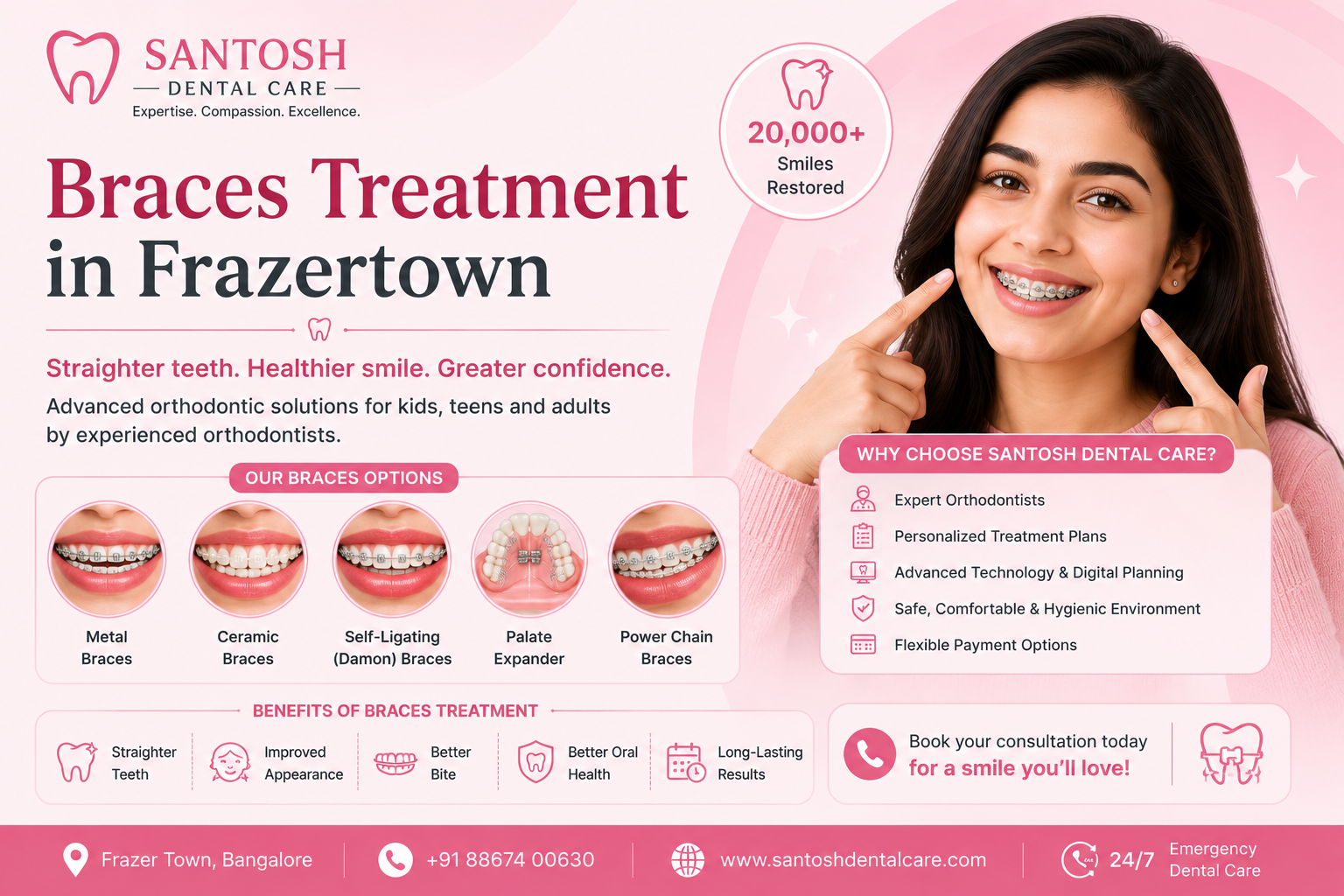
If you are looking for Braces Treatment in Frazer Town, Santosh Dental Care provides personalized orthodontic evaluation and treatment planning based on tooth position, bite, jaw alignment and long-term stability.
Santosh Dental Care’s orthodontic approach focuses on accurate assessment, controlled tooth movement, comfort and retention rather than simply making teeth appear straighter. The clinic offers fixed braces, ceramic braces, invisible orthodontic options and clear aligners depending on the patient’s clinical requirements.
The clinic is led by Dr. Sheetal B. Saklecha, BDS, MDS – Prosthodontics & Crown & Bridge, who has over 21 years of overall clinical experience and more than 20 years of specialist practice.
Book Appointment
What Is Braces Treatment?
Braces are fixed orthodontic appliances used to apply controlled forces to teeth over time. They can help correct problems such as:
- Crowded teeth
- Crooked or rotated teeth
- Gaps between teeth
- Certain overbites and underbites
- Crossbite
- Uneven tooth positioning
- Some bite-related concerns
The treatment works gradually. As controlled forces are applied, the supporting bone and tissues adapt to the changing position of the teeth.
Santosh Dental Care explains that orthodontic treatment is planned according to tooth position, bite relationship, jaw alignment and retention requirements.
Who May Need Teeth Braces?
You may benefit from an orthodontic assessment if you notice:
- Teeth overlapping one another
- Difficulty cleaning between crowded teeth
- Large gaps between teeth
- Teeth that appear rotated or tilted
- Problems with the way upper and lower teeth meet
- A crossbite or other bite concern
- Changes in your bite over time
- Teeth that have shifted after previous orthodontic treatment
Orthodontic evaluation can be performed at different ages. Children and teenagers may benefit from assessing jaw development, while adults can also undergo orthodontic treatment when their teeth, gums and supporting structures are suitable.
Types of Braces Available
There is no single type of braces that is ideal for every patient. Your orthodontist should select the appliance according to the movements required and your individual dental condition.
Traditional Metal Braces
Metal braces use brackets and wires to guide teeth into planned positions.
They are commonly used for a wide range of orthodontic problems, including more complex alignment and bite corrections.
Ceramic Braces
Ceramic braces use tooth-coloured components, making them less noticeable than conventional metal braces.
They may be suitable for teenagers and adults who want a fixed orthodontic appliance with a more discreet appearance. Santosh Dental Care specifically lists ceramic braces among its orthodontic treatment options.
Damon Braces
Damon braces are a type of self-ligating fixed orthodontic system. They use a bracket mechanism to hold the archwire rather than relying on conventional elastic ligatures.
The suitability of a Damon system depends on the patient’s orthodontic diagnosis and the movements required. It should not be selected simply because of claims about faster treatment.
Self-Ligating Braces
Self-ligating systems use brackets with an integrated mechanism for retaining the orthodontic wire.
They are another fixed-braces option that may be considered depending on the patient’s treatment requirements.
Braces vs Aligners: Which Should You Choose?
Patients frequently compare braces and aligners before starting treatment.
Both can move teeth, but they work differently.
Braces
Braces are fixed to the teeth and continuously provide controlled forces according to the treatment plan.
They may be particularly useful when complex or precise tooth movements are required.
Teeth Aligners
Teeth aligners, also known as clear aligners, are removable transparent trays that move teeth through a sequence of planned stages.
They can be an attractive option for selected patients who prefer a less noticeable appliance.
However, aligners depend on patient compliance. They need to be worn as directed for the treatment to progress properly.
Which Is Better?
There is no universal answer to braces vs aligners.
The decision should consider:
- Type of malocclusion
- Complexity of tooth movement
- Bite relationship
- Patient age
- Oral hygiene
- Lifestyle
- Treatment compliance
- Desired treatment outcome
A clinical examination is more useful than choosing an appliance based solely on appearance or advertised treatment duration.
What Are Invisalign Braces?
Invisalign braces is a commonly searched term for Invisalign clear aligner treatment. Invisalign is a specific branded clear-aligner system, whereas “clear aligners” is the broader category.
Patients searching for Invisalign should first determine whether clear aligner treatment is appropriate for their particular orthodontic problem.
Not every alignment issue is best treated with aligners, and some cases may benefit from fixed braces.
What Is a Palate Expander?
A palate expander is an orthodontic appliance used in selected patients to widen the upper jaw or address certain transverse discrepancies.
Expansion may be considered when the upper jaw is narrower than appropriate relative to the lower jaw.
The timing and type of expansion depend on factors such as:
- Age
- Jaw development
- Bone maturity
- Type of bite problem
- Amount of expansion required
The term expander teeth may be used in searches relating to teeth expansion, but expansion should always be professionally planned. It is not simply a cosmetic procedure for making teeth look wider.
Santosh Dental Care’s dentofacial orthopedics service specifically considers jaw development and skeletal relationships when planning orthodontic treatment.
What Are Power Chain Braces?
Power chain braces generally refer to elastic chains placed over orthodontic brackets to apply force across multiple teeth.
They may be used during particular stages of orthodontic treatment, including selected space-closure procedures.
Whether a power chain is required depends on your treatment plan. It is not automatically used for every braces patient.
What Are the Advantages of Braces?
The advantages of braces depend on the patient’s specific condition, but fixed orthodontic treatment can offer several practical benefits:
- Precise control of tooth movement
- Continuous application of orthodontic forces
- Treatment of a wide range of alignment problems
- Ability to address certain complex bite issues
- No requirement to remove the appliance for daily wear
Braces can also improve access for cleaning once crowded or overlapping teeth are properly aligned.
The objective, however, should not be to straighten teeth alone. Santosh Dental Care’s orthodontic approach also considers chewing function, bite balance, jaw relationship and long-term stability.
What Does Dental Braces Cost in Bangalore?
Patients searching for dental braces cost in Bangalore will find a wide range of advertised prices.
There is no single cost that applies to every patient because treatment complexity differs.
Factors that can affect the overall cost include:
- Type of braces
- Severity of alignment problem
- Bite correction required
- Diagnostic imaging
- Treatment duration
- Number of appointments
- Additional orthodontic appliances
- Retainers after treatment
A straightforward alignment case may have different requirements from a patient with significant crowding, bite problems or jaw imbalance.
The most useful way to compare treatment costs is to ask what is included in the proposed treatment plan rather than comparing advertised starting prices.
How Long Does Braces Treatment Take?
Orthodontic treatment does not have one fixed timeline.
Santosh Dental Care states that orthodontic treatment duration can range from several months to a few years, depending on alignment complexity and bite problems.
Treatment duration can be influenced by:
- Initial tooth position
- Crowding
- Gaps
- Bite correction
- Jaw relationship
- Type of orthodontic appliance
- Patient compliance
- Attendance at scheduled appointments
- Biological response to tooth movement
Your orthodontist can provide a more meaningful estimate after examining your teeth and bite.
What Happens During Braces Treatment?
Step 1: Initial Consultation
Your teeth, gums, bite and overall oral health are examined.
Step 2: Diagnostic Assessment
Depending on your case, photographs, X-rays, scans or other diagnostic records may be recommended.
Step 3: Treatment Planning
Your orthodontist determines the appropriate appliance and treatment sequence.
Step 4: Braces Placement
The selected brackets and wires are placed and adjusted according to your treatment plan.
Step 5: Regular Monitoring
Follow-up appointments allow your orthodontist to monitor tooth movement and make necessary adjustments.
Step 6: Braces Removal
Once the planned tooth movement is achieved, the braces are removed.
Step 7: Retention
Retainers help maintain the corrected tooth positions after active treatment.
Retention is important because teeth can naturally shift after orthodontic treatment.
Can You Get Braces If You Have Calculus?
If you have significant plaque or tartar buildup, it should be addressed before or during orthodontic treatment.
A calculus bridge refers to a substantial hardened accumulation of dental calculus. Santosh Dental Care notes that professional cleaning is required for safe removal of hardened tartar deposits.
Healthy gums are important before starting orthodontic treatment because braces can make daily cleaning more challenging.
Your dentist may therefore recommend professional cleaning and gum assessment before braces when clinically necessary.
What Does “Braceless Teeth” Mean?
Braceless teeth is a popular search phrase used by people who want straighter teeth without conventional fixed braces.
Depending on the case, alternatives may include:
- Clear aligners
- Certain removable orthodontic appliances
- Other clinically appropriate orthodontic methods
However, not every case can be treated without fixed braces.
The appropriate treatment should be selected based on the actual tooth and bite problem rather than the desire to avoid braces alone.
Why Choose Santosh Dental Care for Braces in Frazer Town?
Santosh Dental Care follows a patient-focused orthodontic approach that emphasizes assessment before treatment.
Patients benefit from:
- Individualized orthodontic planning
- Evaluation of teeth and bite
- Jaw alignment assessment
- Discussion of suitable orthodontic options
- Digital diagnostic support where appropriate
- Structured treatment monitoring
- Retention planning
- Clear explanation of treatment stages
- A calm and hygienic clinical environment
Meet Dr. Sheetal B. Saklecha
Dr. Sheetal B. Saklecha, BDS, MDS – Prosthodontics & Crown & Bridge, is the lead dentist at Santosh Dental Care.
The current clinic profile states that she has over 21 years of overall clinical experience and more than 20 years of specialist practice. Her expertise includes dental implants, smile designing, cosmetic dentistry, crowns and bridges, dentures, full-mouth rehabilitation and restorative dentistry.
Santosh Dental Care’s current published information also highlights 20,000+ smiles restored and 24/7 emergency dental care.
The clinic is conveniently located in Frazer Town, Bangalore, near Coles Park, Mosque Road and MM Road, serving patients from nearby areas including Cox Town, Cooke Town, Shivajinagar, RT Nagar, Jayamahal, Banaswadi, Ulsoor, Indiranagar and Hebbal.
Book Appointment
Book a Braces Consultation in Frazer Town
Straightening teeth is not simply about creating a visually aligned smile. A well-planned orthodontic treatment should also consider your bite, jaw relationship, oral hygiene, comfort and long-term stability.
Whether you are considering teeth braces, ceramic braces, Damon braces, braces and aligners, or an alternative such as teeth aligners, the first step is a professional assessment.
