

Losing a tooth can affect much more than the appearance of your smile. A missing tooth may make chewing less comfortable, affect speech, change the way neighbouring teeth meet, and make some people feel less confident when they smile. For suitable patients, dental implants offer a fixed option for replacing missing teeth.
A dental implant is designed to replace the root portion of a missing tooth. It can then support a crown, bridge, denture, or full-arch restoration. Unlike a removable denture, an implant-supported tooth is anchored to the jawbone.
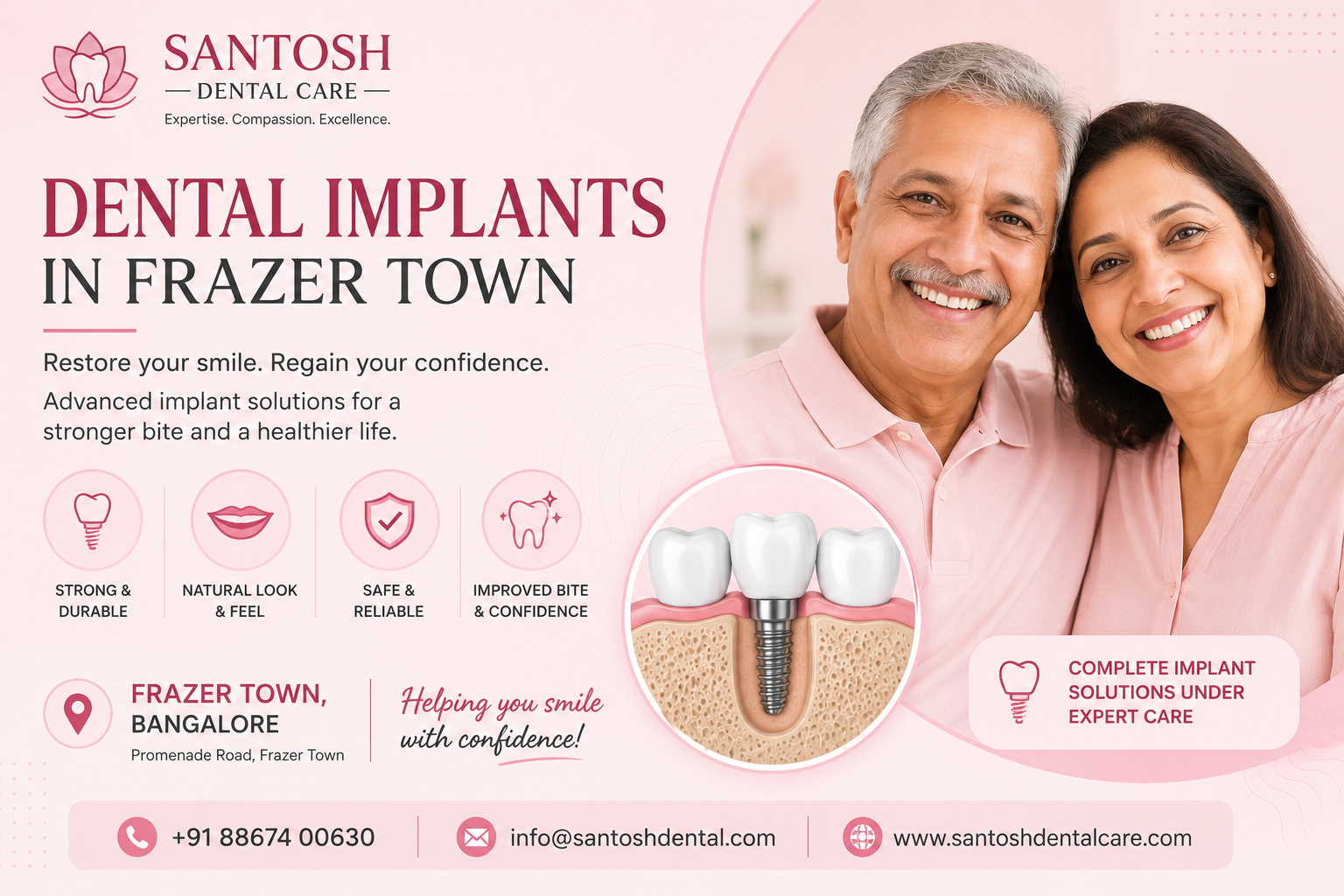
However, implant treatment is not simply a matter of placing a screw into the jaw. Good results depend on appropriate patient selection, healthy gums, sufficient bone support, accurate planning, suitable restoration, and long-term maintenance. NHS guidance similarly describes implants as artificial tooth-root replacements that can support crowns, bridges, or dentures.
At Santosh Dental Care in Frazer Town, implant treatment planning is led by Dr. Sheetal B. Saklecha, MDS – Prosthodontics & Crown/Bridge. The clinic describes a consultation-and-diagnosis-first approach, with treatment options explained before proceeding. Its current website lists Dental Implants in Frazer Town, All-on-4/full-mouth implants, general dentistry, smile designing, and preventive dental care among its services.
Whether you have lost one tooth or several teeth, the first step is understanding whether an implant is appropriate for your particular dental condition.
Book consultation
What Are Dental Implants?
Dental implants are artificial tooth-root replacements placed into the jawbone to support replacement teeth.
A conventional implant-supported tooth generally consists of:
Implant Fixture
The implant fixture is positioned within the jawbone and provides the foundation for the replacement tooth.
Abutment
The abutment connects the implant to the final dental restoration.
Crown
The crown is the visible replacement tooth designed to restore appearance and chewing function.
Depending on the situation, implants can also support:
- Dental bridges
- Implant-retained dentures
- Full-arch fixed teeth
- All-on-4 restorations
This makes implant treatment useful for different patterns of tooth loss.
Who May Need Dental Implants?
Teeth implants may be considered for adults who have:
- One missing tooth
- Several missing teeth
- Multiple failing teeth
- Complete tooth loss
- Difficulty managing removable dentures
- A need for a fixed tooth-replacement option
However, not everyone is automatically suitable for implant treatment.
Before recommending an implant, a dentist may assess:
- Jawbone quantity and quality
- Gum health
- Oral hygiene
- Existing dental infections
- Bite and chewing forces
- Remaining teeth
- Medical history
- Smoking or tobacco use
- The patient’s expectations and treatment goals
Active dental disease may need to be managed before implant placement.
The Cambridge University Hospitals patient guidance notes that implant suitability is influenced by oral health and the stability of the surrounding dentition, while NHS guidance recommends discussing individual risks and treatment alternatives with the dental team.
Why Replace a Missing Tooth?
A missing tooth can affect several aspects of oral function.
Chewing
Depending on its location, a missing tooth can make certain foods harder to chew.
Bite
The teeth around a missing space can change position over time, potentially affecting how the upper and lower teeth meet.
Appearance
Missing front teeth can have a noticeable effect on the smile.
Speech
Several missing teeth may influence speech sounds.
Bone
The jawbone surrounding a missing tooth no longer receives the same stimulation from a natural tooth root.
The appropriate replacement method depends on the individual patient. An implant is one option; bridges and dentures may also be suitable in certain situations.
Types of Dental Implants and Implant-Supported Solutions
Patients often search for types of dental implants or different type of dental implants. In practice, they may be referring to different implant treatments and restoration designs rather than completely different procedures.
Single-Tooth Implant
A single implant can replace one missing tooth and support an individual crown.
This may be considered when:
- One tooth is missing
- Adjacent teeth are suitable
- Bone support is adequate
- The patient is suitable for implant treatment
One advantage is that the neighbouring teeth generally do not need to be used as bridge supports.
Multiple Dental Implants
When several teeth are missing, two or more implants may be used to support individual crowns or an implant-supported bridge.
The number and location of implants depend on the clinical situation.
Full-Mouth Dental Implants
Full-mouth dental implants or full-arch implant rehabilitation may be considered for patients who have lost most or all teeth or have multiple teeth with a poor prognosis.
Instead of placing a separate implant for every missing tooth, strategically positioned implants may support a full-arch prosthesis.
Treatment planning considers:
- Bone availability
- Gum health
- Existing teeth
- Bite
- Facial aesthetics
- Chewing requirements
- Long-term maintenance
All-on-4 Dental Implants
All on 4 dental implants are a full-arch treatment concept where a fixed prosthesis is supported by four strategically positioned implants in appropriately selected patients.
Santosh Dental Care currently lists All-on-4 / Full Mouth Implants as one of its services.
All-on-4 is not automatically suitable for every patient. A detailed clinical examination and imaging are required before deciding on the treatment design.
What Is the Dental Implant Procedure?
Patients considering implant surgery often want to know what the overall process involves.
The exact treatment plan varies, but implant treatment commonly includes several stages.
1. Consultation and Examination
Your dentist reviews your dental history and examines your teeth, gums, bite, and missing-tooth area.
2. Diagnostic Imaging
X-rays or 3D imaging may be used when clinically indicated to evaluate bone and important anatomical structures.
3. Treatment Planning
The dentist determines:
- Implant position
- Number of implants
- Restoration type
- Need for additional procedures
- Expected treatment stages
4. Implant Placement
The implant is placed into the planned area using appropriate anesthesia.
5. Healing
The implant needs time to integrate with the surrounding bone before it can reliably support the definitive restoration.
6. Final Restoration
A crown, bridge, denture, or full-arch restoration is fitted after appropriate healing and assessment.
NHS patient information describes implant treatment as involving assessment, possible bone grafting when needed, implant placement, and restorative treatment. The overall timeline varies considerably between patients.
Is Implant Surgery Painful?
The concern about pain is common when patients hear the term dental surgery or implant surgery.
Implant placement is generally performed under local anesthesia, which numbs the treatment area. Patients may still feel pressure or movement during treatment, but sharp pain should be controlled.
After surgery, some patients may experience:
- Swelling
- Tenderness
- Bruising
- Mild bleeding
- Temporary discomfort
The intensity depends on the number of implants and the complexity of the treatment.
Guy’s and St Thomas’ NHS Foundation Trust notes that soreness, swelling, bleeding, or bruising can occur after implant treatment and that discomfort varies between individuals.
If pain or swelling becomes unusually severe or continues to worsen, the treating dentist should be contacted.
What If There Is Not Enough Bone for an Implant?
Adequate bone support is important for implant stability.
Some patients may have reduced bone volume because of:
- Long-standing tooth loss
- Previous infection
- Gum disease
- Trauma
- Natural bone anatomy
If there is insufficient bone, a dentist may discuss procedures such as bone grafting or other approaches.
Bone grafting is not required for every implant patient. NHS specialist guidance confirms that some patients need bone grafting when there is insufficient jawbone to support an implant.
The decision should be based on imaging and clinical assessment.
Can an Implant Be Placed After Tooth Extraction?
In selected cases, an implant may be placed immediately after a tooth is removed.
This is called immediate implant placement.
However, immediate placement is not appropriate for every extraction site. The dentist may consider:
- Infection
- Bone condition
- Gum and soft-tissue health
- Location of the tooth
- Ability to achieve implant stability
- Overall treatment requirements
If immediate placement is unsuitable, the dentist may recommend allowing the site to heal before implant placement.
Dental Implants vs Other Dental Solutions
An implant is not automatically the right solution for every missing tooth.
Dental Implants
An implant replaces the tooth root and supports a restoration.
Dental Bridge
A bridge replaces a missing tooth using neighbouring teeth or implants for support.
Dentures
Dentures are removable appliances used to replace several or all missing teeth.
Implant-Supported Dentures
Implants can provide additional support and retention for certain removable dentures.
The choice depends on oral health, bone, gum condition, number of missing teeth, functional needs, aesthetics, maintenance requirements, and personal preferences.
A responsible treatment plan should explain both the recommended option and suitable alternatives.
What Determines the Cost of Dental Implants?
Patients often search for dental implant cost, teeth implant cost, or even dental transplant cost.
There is no single price applicable to every implant case.
The overall treatment cost may be influenced by:
- Number of implants
- Implant system and components
- Diagnostic imaging
- Type of final restoration
- Crown material
- Laboratory work
- Bone grafting, if required
- Sinus augmentation, if required
- Temporary restoration
- Full-mouth rehabilitation
- Complexity of the case
- Follow-up requirements
For example, replacing one tooth with a single implant is very different from full-arch implant rehabilitation.
Dental Transplant vs Dental Implant
The phrase dental transplant is sometimes used incorrectly to describe dental implants.
They are not the same.
A dental implant is an artificial tooth-root replacement placed into the jawbone.
Tooth transplantation involves moving a natural tooth from one site to another in selected clinical circumstances.
Patients should clarify the exact procedure being recommended rather than comparing costs based only on search terminology.
Dental Implants and Oral Hygiene
Good oral hygiene remains important after implant treatment.
An implant cannot develop tooth decay in the same way as a natural tooth, but the tissues around an implant can still develop inflammation and disease.
Patients should:
- Brush regularly with appropriate fluoride toothpaste
- Clean between teeth
- Follow the dentist’s implant-cleaning instructions
- Attend regular dental examinations
- Have professional cleaning when recommended
- Manage gum problems promptly
- Avoid tobacco
- Report persistent bleeding, swelling, discomfort, or implant movement
The NHS recommends regular dental care and good oral hygiene, while specialist implant guidance emphasizes long-term maintenance and follow-up.
How Long Do Dental Implants Last?
Dental implants are designed as a long-term tooth-replacement option, but no responsible dentist should guarantee a specific lifespan for every patient.
Long-term implant health can be influenced by:
- Oral hygiene
- Gum health
- Bone support
- Bite forces
- Smoking
- Overall health
- Quality of restoration
- Regular maintenance
The implant and the visible crown are separate components, and they may have different maintenance or replacement requirements.
Regular dental reviews are therefore an important part of implant care.
Dental Implants vs Teeth Whitening
Patients sometimes search for an implant dentist while also considering cosmetic dental treatments such as teeth whitening.
These treatments solve different problems.
Teeth Whitening
Whitening is designed to lighten the colour of suitable natural teeth.
Dental Implants
Implants replace missing teeth.
If a patient has both missing teeth and concerns about tooth shade, the dentist may need to consider the treatments together when planning the final restoration.
For example, the shade of a new implant crown may need to be coordinated with the appearance of the surrounding teeth.
Why Choose Santosh Dental Care for Dental Implants in Frazer Town?
Santosh Dental Care is located near Coles Park on Promenade Road in Frazer Town, Bangalore. Its current website identifies Dental Implants in Frazer Town and All-on-4 / Full Mouth Implants among its services.
The clinic’s treatment approach includes:
Consultation and Digital Diagnosis
Santosh Dental Care describes consultation and diagnosis as the first stage of treatment, with X-rays or scans recommended when required.
Specialist-Led Planning
Dr. Sheetal B. Saklecha, MDS – Prosthodontics & Crown/Bridge, leads treatment planning for implants and restorative cases.
Bite-Focused Treatment Planning
The clinic specifically states that implant planning considers bite balance, long-term comfort, and stable chewing.
Multiple Treatment Options
Patients are provided with treatment options and explanations before proceeding rather than being rushed into a procedure.
Comprehensive Dental Care
Alongside implants, the clinic offers general dentistry and preventive care, including check-ups, cleaning, fillings, and gum care.
This broader approach can be useful when a patient has several dental concerns that need to be considered together.
Meet Dr. Sheetal B. Saklecha
Dr. Sheetal B. Saklecha, MDS – Prosthodontics & Crown/Bridge, is the lead dentist and prosthodontist at Santosh Dental Care.
Her prosthodontic background is relevant to implant treatment because implant dentistry involves more than implant placement. The final restoration must also be planned for function, appearance, bite, and long-term maintenance.
At Santosh Dental Care, her treatment-planning responsibilities include implants, restorative cases, smile corrections, and other prosthodontic treatments.
The clinic’s current profile emphasizes:
- Diagnosis before treatment
- Clear explanation of treatment options
- Personalized treatment planning
- Bite stability
- Long-term function
- Natural aesthetics
- Follow-up guidance
Your Dental Implant Journey at Santosh Dental Care
Step 1: Consultation
Discuss your missing tooth or teeth, dental history, concerns, and treatment expectations.
Step 2: Dental Examination
Your dentist assesses teeth, gums, bite, and the proposed implant area.
Step 3: Imaging
X-rays or scans may be recommended to assess bone and anatomical structures.
Step 4: Treatment Planning
The dentist explains suitable implant and alternative tooth-replacement options.
Step 5: Implant Treatment
Implant placement and any necessary supporting procedures are carried out according to the treatment plan.
Step 6: Healing
The implant is allowed to heal and integrate with the surrounding bone.
Step 7: Final Restoration
The final crown, bridge, denture, or full-arch restoration is fitted.
Step 8: Maintenance
Regular examinations and appropriate oral hygiene help monitor the implant and surrounding tissues.
When Should You Consult an Implant Dentist?
Consider a dental consultation if you have:
- A missing tooth
- Multiple missing teeth
- A recently extracted tooth
- Difficulty wearing a denture
- A failing bridge
- Severely damaged teeth
- Difficulty chewing
- Concerns about replacing missing teeth
You do not need to decide on an implant before your appointment.
The purpose of the consultation is to determine whether an implant is suitable and explain other possible dental solutions.
Dental Clinic in Frazer Town for Complete Dental Care
Patients searching for a dental clinic Bangalore, the dental clinic near Frazer Town, or comprehensive dental solutions may need treatment beyond implants.
Santosh Dental Care provides services including:
- Dental implants
- All-on-4/full-mouth implants
- General dentistry
- Dental cleaning
- Fillings
- Gum care
- Crowns and bridges
- Veneers and smile designing
- Braces and clear aligners
- Kids dentistry
- Preventive dental care
- Emergency dental care
The clinic is located near Coles Park on Promenade Road and serves patients from Frazer Town and nearby central Bengaluru areas.
Book Consultation
If you are considering dental implants for one or more missing teeth, a professional assessment is the best starting point.
At Santosh Dental Care, the implant consultation focuses on understanding your oral health, evaluating bone and gum support, discussing suitable treatment options, and planning the final restoration.
Patients from Frazer Town and nearby Bengaluru areas can contact the clinic to discuss their tooth-replacement needs.
