

Restoring Oral Function, Aesthetics and Confidence in an 84-Year-Old Patient
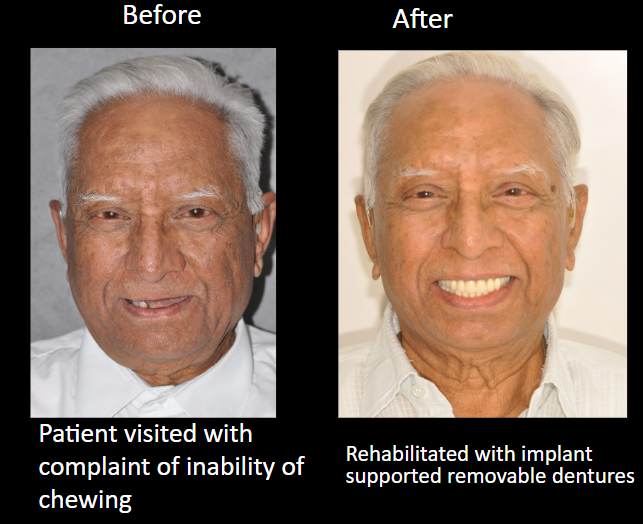
An 84-year-old patient, A.K. Subramaniam, came to Santosh Dental Care with several missing teeth, failing bridges and restorations. His dental condition had significantly affected his ability to chew food, and he wanted to restore his oral health and regain better function.
Following a comprehensive assessment that included routine blood investigations, full-mouth radiographs and CBCT scans of both jaws, the condition of the available bone was assessed.
Based on the evaluation, a treatment plan for full mouth rehabilitation with implants and a removable implant prosthesis was provided.
The treatment involved full-mouth extraction, guided implant placement using an All-on-6 approach, placement of multi-unit abutments, and delivery of an immediate temporary denture. After three months, the final implant-supported removable denture was fabricated and delivered.
Follow-up at 3 months, 6 months and 1 year showed that the patient had regained oral function and aesthetics, with the treatment also enhancing his confidence.
Case Snapshot
| Case Detail | Information |
| Patient | A.K. Subramaniam |
| Age | 84 years |
| Main concerns | Multiple missing teeth, failing bridges and restorations |
| Functional concern | Difficulty chewing food |
| Initial assessment | Routine blood investigations, full-mouth radiographs and CBCT scans |
| Bone assessment | Both jaws evaluated using radiographic and CBCT imaging |
| Treatment plan | Full mouth rehabilitation with implants and removable implant prosthesis |
| Extraction | Full-mouth extraction, with lower right third molar retained |
| Implant approach | Guided implant surgery using All-on-6 implants |
| Surgical guidance | Stackable guides |
| Abutments | Multi-unit abutments |
| Immediate prosthesis | Temporary denture |
| Final prosthesis | Implant-supported removable denture |
| Follow-up | 3 months, 6 months and 1 year |
| Outcome | Function and aesthetics regained; confidence enhanced |
What Was the Patient’s Dental Problem?
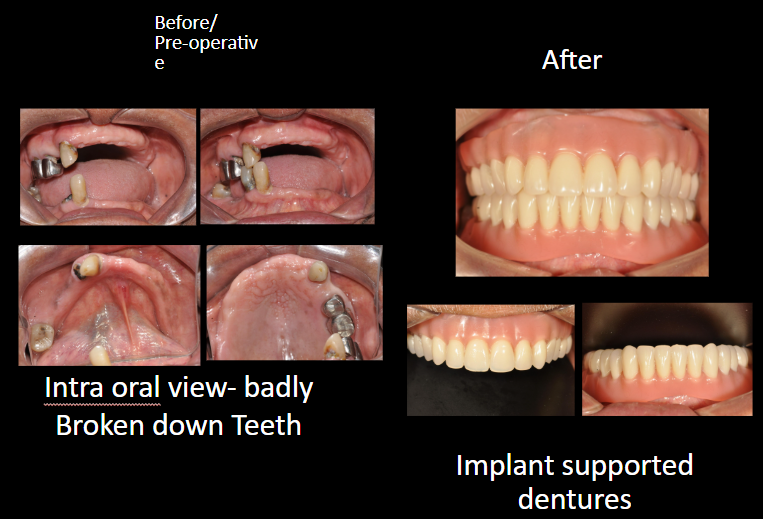
A.K. Subramaniam, an 84-year-old patient, presented with several missing teeth along with failing bridges and restorations.
His dental condition was affecting an important everyday function: chewing food.
Rather than addressing individual failing teeth or restorations separately, the objective was to assess his overall oral condition and develop a comprehensive rehabilitation plan.
The patient’s primary goal was to get his oral health restored and improve his ability to function comfortably.
How Was His Oral Health Evaluated?
Before developing the treatment plan, a comprehensive assessment was carried out.
The evaluation included:
- Routine blood investigations
- Full-mouth radiographs
- CBCT scans of both jaws
The radiographic and CBCT assessment was used to evaluate the bone health of both jaws and assist in planning the implant rehabilitation.
This assessment was important because implant treatment requires appropriate evaluation of the available oral and jaw structures before implant placement is planned.
Treatment Planning for Full Mouth Rehabilitation
Following the assessment, a treatment plan for full mouth rehabilitation with implants and a removable implant prosthesis was provided.
The objective was to address the patient’s overall dental condition rather than treating individual missing or failing teeth in isolation.
The planned rehabilitation included:
- Removal of the existing compromised teeth.
- Evaluation and preservation of the sound lower right third molar.
- Guided implant surgery.
- Placement of implants using an All-on-6 approach.
- Placement of multi-unit abutments.
- Delivery of an immediate temporary denture.
- Fabrication of the final implant-supported removable denture after three months.
- Long-term follow-up to evaluate function and aesthetics.
Full Mouth Extraction
As part of the rehabilitation, full-mouth extraction was performed.
However, the lower right third molar was retained because it was considered sound periodontally.
This illustrates that the treatment plan was not simply based on removing every remaining tooth. The retained tooth was specifically noted to have favourable periodontal condition.
Guided Implant Surgery with All-on-6 Implants
Following the extraction phase, guided implant surgery using an All-on-6 approach was planned.
Stackable guides were used during implant placement.
Guided implant surgery allows implant placement to be carried out according to the planned surgical positioning.
In this case, the guided approach formed part of the overall rehabilitation plan for replacing the patient’s missing teeth and supporting the planned prosthesis.
Placement of Multi-Unit Abutments
Following implant placement, multi-unit abutments were placed.
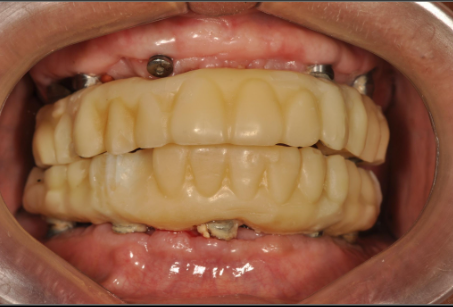
Temporary dentures – to allow implants to stabilize in the bone
These components formed part of the implant-supported rehabilitation and provided the connection required for the prosthetic phase of treatment.
The use of multi-unit abutments was incorporated into the planned full-mouth rehabilitation.
Immediate Temporary Denture
An immediate temporary denture was fabricated and delivered following the implant surgery.
This allowed the patient to enter the provisional stage of his rehabilitation while the treatment progressed toward the final implant-supported prosthesis.
The temporary prosthesis therefore served as an important stage between implant surgery and delivery of the final restoration.
Final Implant-Supported Removable Denture
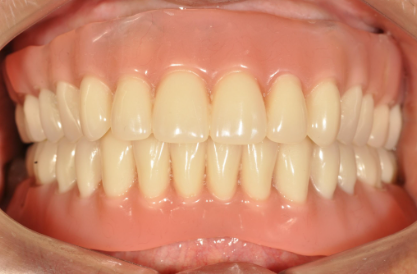
After three months, the final implant-supported removable denture was fabricated and delivered.
This marked the transition from the temporary stage of treatment to the final prosthetic rehabilitation.
The final prosthesis was designed as part of the comprehensive full-mouth rehabilitation planned for the patient.
Follow-Up at 3 Months, 6 Months and 1 Year
Follow-up formed an important part of the patient’s rehabilitation journey.
The patient was reviewed at:
- 3 months
- 6 months
- 1 year
These follow-ups showed that the patient had regained function and aesthetics.
The outcome also had an important personal impact: the treatment enhanced his confidence.
For an elderly patient whose dental condition had previously affected his ability to chew, the improvement in both oral function and confidence represented an important outcome of the rehabilitation.
Patient Outcome
The treatment addressed both the functional and aesthetic aspects of the patient’s dental condition.
Before Treatment
- Several missing teeth
- Failing bridges and restorations
- Difficulty chewing food
- Desire to restore oral health
Treatment
- Full-mouth extraction, with the sound lower right third molar retained
- Guided implant surgery
- All-on-6 implant approach
- Multi-unit abutments
- Immediate temporary denture
- Final implant-supported removable denture after three months
Follow-Up
- 3 months
- 6 months
- 1 year
Outcome
- Function regained
- Aesthetics improved
- Confidence enhanced
What This Case Demonstrates
A.K. Subramaniam’s case demonstrates the importance of comprehensive assessment and treatment planning in full mouth rehabilitation.
The patient’s treatment involved multiple stages rather than a single procedure.
The overall rehabilitation included:
Assessment → Treatment planning → Extraction → Guided implant surgery → Multi-unit abutments → Temporary denture → Final implant-supported removable denture → Long-term follow-up
The case also highlights the importance of considering the patient’s individual dental condition when planning treatment. Although full-mouth extraction was performed, the lower right third molar was retained because it was sound periodontally.
Why Was CBCT Used in Treatment Planning?
CBCT scans of both jaws were performed as part of the patient’s assessment.
The scans contributed to evaluation of the bone health before implant treatment was planned.
Along with full-mouth radiographs and routine blood investigations, this assessment helped inform the treatment plan for full mouth rehabilitation with implants and a removable implant prosthesis.
Why Was Guided Implant Surgery Planned?
Guided implant surgery was planned as part of the patient’s implant rehabilitation.
In this case, stackable guides were used for implant placement as part of the All-on-6 approach.
The guided surgical process was incorporated into the treatment plan following assessment of the patient’s jaws and bone condition.
Why Was an Immediate Temporary Denture Provided?
After implant placement and multi-unit abutment placement, an immediate temporary denture was fabricated and delivered.
This provided the patient with a temporary prosthetic solution while treatment progressed toward fabrication of the final implant-supported removable denture.
The final prosthesis was delivered after three months.
Why Is Follow-Up Important After Full Mouth Rehabilitation?
The patient’s rehabilitation did not end with delivery of the final denture.
Follow-up was conducted at:
- 3 months
- 6 months
- 1 year
These reviews showed that the patient had regained function and aesthetics and that the treatment had enhanced his confidence.
Regular follow-up is therefore an important part of documenting the longer-term outcome of a comprehensive rehabilitation case.
Doctor’s Clinical Takeaway
A comprehensive full mouth rehabilitation requires careful assessment, treatment planning and coordination between the surgical and prosthetic stages.
In this case, the patient’s multiple missing teeth, failing bridges and restorations, and difficulty chewing required a broader rehabilitation approach.
The treatment progressed through assessment, extraction, guided implant placement, temporary prosthetic rehabilitation and final implant-supported restoration, followed by longer-term follow-up.
The patient’s subsequent improvement in function, aesthetics and confidence highlights the broader impact that comprehensive oral rehabilitation can have on a patient’s quality of life.
Conclusion
A.K. Subramaniam, an 84-year-old patient, came to Santosh Dental Care with several missing teeth, failing bridges and restorations that had made chewing difficult.
After routine blood investigations, full-mouth radiographs and CBCT scans of both jaws, his bone health was assessed and a treatment plan for full mouth rehabilitation with implants and a removable implant prosthesis was developed.
The treatment included full-mouth extraction, retention of a sound lower right third molar, guided implant surgery using an All-on-6 approach, multi-unit abutments and an immediate temporary denture. After three months, the final implant-supported removable denture was fabricated and delivered.
Follow-up at 3 months, 6 months and 1 year showed that the patient had regained function and aesthetics, while the rehabilitation also enhanced his confidence.
This case demonstrates how a comprehensive, staged approach can address the functional and aesthetic needs of a patient requiring extensive dental rehabilitation.
Need Full Mouth Rehabilitation?
If you have multiple missing teeth, failing dental restorations or difficulty chewing, a comprehensive dental evaluation can help determine the appropriate treatment options for your individual needs.
Book a consultation with Santosh Dental Care to discuss your oral rehabilitation needs
